
Showing posts with label couscous. Show all posts

September 3, 2012

Spicy roasted bell pepper peanut sauce


Okra

Avondale Saison at Epiphany in Tuscaloosa

This summer, I had a few opportunities to eat at Epiphany Cafe in downtown Tuscaloosa, AL. Epiphany sources and features Alabama grown produce on their menu (they also go local with their beers, meats, and dairy too). I like sampling the small plates, as they are generous portions to share. Now, I'm not a foodie critic, and I rarely write about restaurant meals, but this place just floors me each time. For someone that cooks a lot, I'm impressed when restaurant meals are something that I would not prepare at home. I want to be impressed. A quick glance at their menu, shows a description of foods and flavors - they really work it. 

Last week, they had a special 3-course menu for restaurant week: hay-smoked scallops served with coin-thin sliced cucumbers and drizzles of soy sauce, flash-fried and crunchy fish with radishes and slivers of dainty grassy chives served over potatoes, and to finish off the meal a rich (I would think brown sugar) pound cake featuring Chilton County peaches. All this for 30 bucks - no splitting though. I ate all of it. 

Each time I've gone, I try to sample new things. They tend to change the menu frequently. One dish that has stuck with me, and that I absolutely adored was a roasted okra with a red bell pepper coulis. If you love okra, you've got to try it roasted. 

After settling in and unpacking the kitchen, one visits the farmers' markets. There was a lot of good looking late summer produce around. Pretty purple and green okra pods, hot peppers, tomatoes, dimpled and firm summer squash, flowers, basil, eggplants. I knew I had to recreate that okra dish. I didn't want to view the menu to see what flavors I had loved so much, I wanted to go off memory, and what we had around. Turning the oven on in the middle of summer here was not the best idea, but so be it when you want roasted okra.  

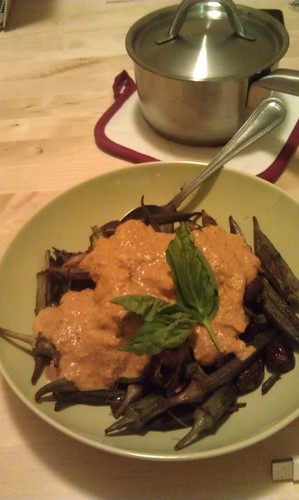
I made a roasted bell pepper sauce/chutney, and served it over just roasted okra, and topped it with some fresh basil. I served mine alongside some couscous, which proved a bit boring, but was a key sauce soaker-upper. This is a delicious dish. Choose young fresh okra. If the okra is too mature, the seeds will be an unpleasant crunch, and the skins can get too tough and fibrous. Young pods should be 3-4" in length or smaller. 

Spicy roasted bell pepper peanut sauce served with roasted okra and couscous
Serves: 4, or 2 hungry people; recipe inspired from Epiphany Cafe, Tuscaloosa, AL

Ingredients:
1-2 red bell peppers 
1-2 hot peppers, or jalapeños 
2 cloves garlic
2-3 tbsp olive oil
1-2 tbsp water
2-3 tbsp parsley, cut off stems
juice of half a lime
1 tbsp soy sauce
large handful roasted peanuts

Roasted okra:
1-2 lbs okra (count 1/2 pound per person)
olive oil

Couscous:
1 cup couscous
1 cup boiling water

Directions:
Turn the broiler on high, and lay out a few red bell peppers and hot peppers on a pan. Broil them until they are nicely charred. Rotating every few minutes until the skins look blistered. Once they are done, set in a heat-proof bowl and cover with a plate. You can set them in the fridge to speed up cooling down time. Boil 1 cup water for the couscous. When the water boils, add the 1 cup dry couscous, stir, and turn off the heat. You can leave the sauce pan with the couscous on the same burner. I think it helps it dry out more quickly. Now, the okra.  

In the same pan, lay out freshly washed okra. Drizzle with olive oil, toss to cover evenly, and roast in the oven at 375º F/ 190º C for about 25 minutes or until baked. Now, the sauce.

In a blender, add roughly chopped parsley, garlic cloves, olive oil, water, the juice of half a lime, 1 tbsp soy sauce, and roasted peanuts. Make sure the bottom of the blender has about 1/2 inch of liquid or more. Blend on low setting, incorporating all the ingredients. Depending on your blender, you might need to scrape the sides of the blender down to incorporate any fly aways. Now, the peppers.

Once the peppers are cool enough to handle, remove the waxy papery skins, and discard the membranes and seeds. Use plastic gloves (or 2 sandwich plastic zip locks) to prep the hot peppers. Once, I rubbed my eye after ignoring the "use rubber gloves" and it was painful enough that now I try and protect my hands from the capsaicin found in peppers. Add the peppers to the blender. Blend until incorporated. Set aside until ready to use. 

Turn out the roasted okra in a nice serving dish. Spoon some of the spicy roasted bell pepper peanut sauce on top, garnish with basil leaves, and serve alongside the couscous. Voilá, lekkere eten! Een echt super lekkere hoofdgerechten die Jeroen Meus jaloers vindt zijn. 

March 30, 2011

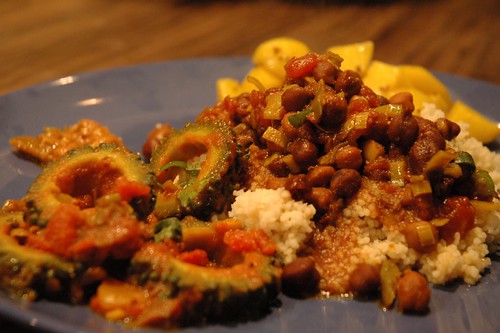
Channa Masala

I love the smaller denser heartier black chickpeas or kala channa, but if you can't find them, regular chickpeas or garbanzo beans are fine. The term chickpeas and garbanzo beans can be used interchangeably, while black chickpeas are actually much smaller and darker. 

Since Indian foods tend to have longer ingredient lists with some hard to find spices (and who wants to buy a spice you'll use once?) try this: omit the things you don't have, and add the ones you do. Harder to find ingredients are marked as optional. This dish freezes well. Channa masala is usually served with rice or chappati (or naan), some yogurt, and salad. Try serving it on top of couscous. Couscous cooks in 5 minutes, and is a timesaver.

Channa Masala or Black Chickpeas Curry
Yield: 4 servings

Ingredients:
1 tsp olive oil
1/2 tsp cumin seeds (optional)
1/2 tsp udad dhal, (optional)
pinch asafoetida (hing), (optional)
1/2 cup onions, diced
1 clove garlic, minced
1 tsp ginger, minced fine
1 small jalapeno, seeded, deveined and minced (optional)
1 tsp turmeric
1 tsp cumin powder
1 tsp paprika
2, 14 oz cans chickpeas/garbanzo beans or 1 and ½ cups black chickpeas or regular chickpeas prepared by soaking and cooking.
1/2 cup canned diced tomatoes (or 1-2 chopped tomatoes)
1 tsp fenugreek powder, if using seeds, toasted and ground (optional)
1/2 cup water
1 tsp garam masala (optional)
cilantro and green onions, optional for garnish
salt to taste

Directions:
  1. Heat up oil in a large soup stockpot. Once hot add in cumin seeds, udad dhal, and hing. Fry until fragrant.
  2. Add in onions, garlic, ginger, and jalapeno. Stir-fry.
  3. Add in turmeric, cumin powder, and paprika. Stir everything together. 
  4. Stir in chickpeas, tomatoes, fenugreek powder, and water. Add more water if too thick. Stir everything together. 
  5. Partially cover and bring to a simmer. Cook 20 minutes.
  6. Stir in garam masala, taste to adjust for salt, and top with cilantro and green onions.

November 26, 2010

Sakkarpara


DSC_0290
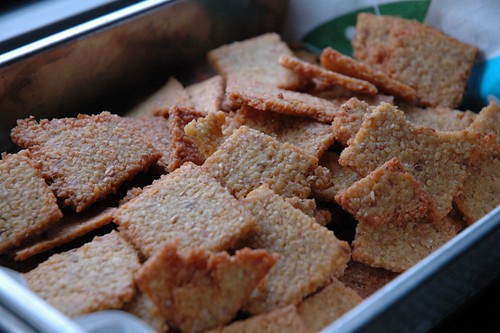
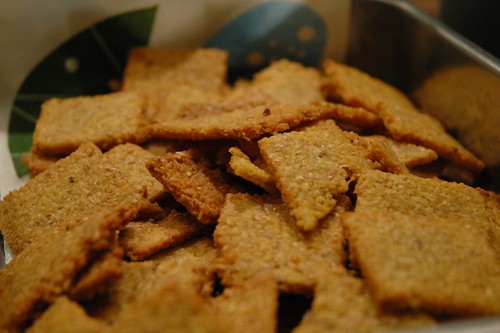
Sakkarpara are fried spicy wheat crisps that are made out of wheat flour and cream of wheat, or semolina flour. These are like spicy chips or crackers. My mom used to make these, and now does so when we visit home, or she travels to see us.  Being away from my parents, I have decided to try my hand at some of those traditional Guju foods my mom made. I imagine that her recipes had to change once she emigrated to the US, similar to how I have had to adapt many recipes because I cannot find the ingredients, or they are unavailable. I was unable to find cream of wheat or semolina flour, so I used a fine ground couscous.
DSC_0233
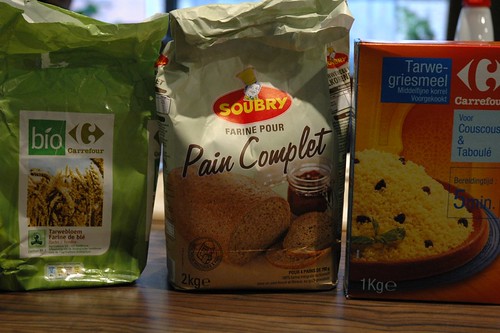
Above: all-purpose flour, whole-wheat flour, and fine semolina

DSC_0237
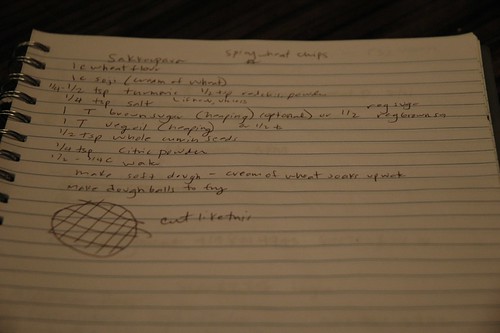
Above: Mom's recipe

Sakkarpara are usually served both savory and sweet. They are usually consumed for breakfast or during tea time.  They travel and store well in airtight containers. I prepared my mom’s recipe in two batches, adjusting the couscous and the wheat flour. I have included her original recipe below, with my adjustments in parentheses besides each item.  I found that they used a lot less oil and cooked quickly while being fried at 300 F. They store well, if you can manage not eating all of them in a few days.
DSC_0243
Above: cumin seeds, turmeric, red chili powder

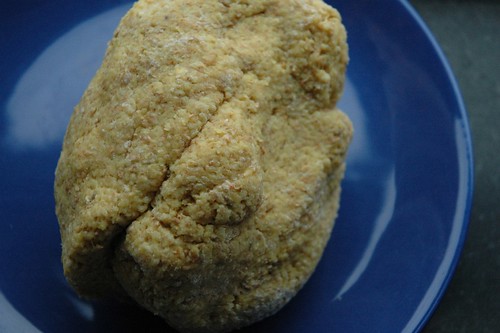
The sakkarpara are ready to fry as soon as the dough has been made and rolled out. If you are not going to fry these immediately, store the dough in a small bowl. To make the rolling easier, split the dough ball into two pieces. Have ample all-purpose flour ready to coat your work surface so the dough will not stick. I used almost 1/2 cup in rolling these out. The chips can be dusted with flour to prevent them from sticking (the extra flour will really tax the frying oil, but you can strain the oil through a tea sieve once its cooled off). The addition of cooked couscous allow these to puff up and gives you a soft wet dough.
DSC_0253
Above: the sakkarpara dough ready to be rolled out. This one is a bit on the drier side, you want it moister than this. 
DSC_0257
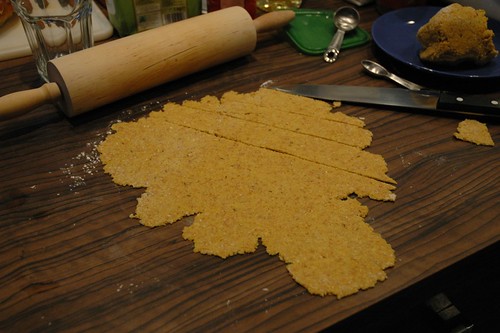
Above: dough is rolled and cut up.
DSC_0264
DSC_0309
Above: ready to make some?

Gujarati Sakkarpara
Yield: 50-60 chips
1 cup wheat flour or mixture of all-purpose and whole-wheat flour
1 cup cream of wheat, or 1/2 cup of dried couscous prepared with 1 cup boiling water. This will yield about 1 and 1/2 cups cooked couscous.
½ tsp turmeric, use ¼ tsp if using fresh turmeric
½ tsp red chili powder
½ tsp whole cumin seeds
½  tsp salt
1 tbsp brown sugar
¼ tsp citric powder (I omitted, because I couldn’t find it)
1 tbsp vegetable oil
1/2 cup water, or more as needed
½ cup flour, set aside
2 cups peanut oil


Directions:
  1. Combine the flour and cream of wheat (or cooked couscous if using) in a large mixing bowl. Next, add in turmeric, red chili powder, salt, cumin seeds, brown sugar and citric acid (if using) and stir well.
  2. Stir in vegetable oil and mix well.
  3. Add in the water in ¼ cup increments, mixing the dough together. You want to make a soft dough, and the cream of wheat will soak up the water (the cooked couscous will make the dough wetter, so you might need more flour).  If the dough is too dry, add in water 1 tsp at a time until you get it to be the right consistency. Form a ball.
  4. Once ready to roll the dough, split the dough into two even balls.
  5. Sprinkle a clean work surface with the reserved flour, and push down the dough (dusted in flour) into a 3-4 inch disc. Roll out the dough, rotating the dough every few rolls, so you can get a circle. Flip it over frequently to make sure it is not sticking. Use more flour as needed. If you get another shape, just work with it, it doesn’t matter. Roll out until ⅛ inch thick.
  6. With a small paring knife, cut strips along the length of the dough, and then cut strips along the width, so you get squares or diamonds. You can flour these lightly, so they do not stick.
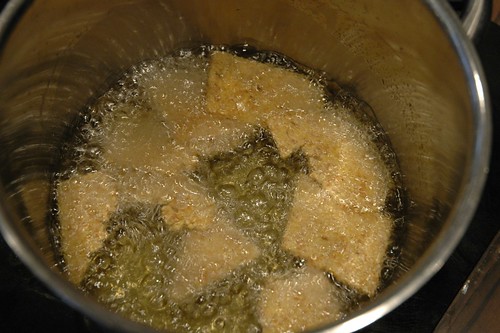
  7. Heat up the 2 cups of peanut oil in a wide oil-safe pot over medium-high heat.  The oil is ready when it is between 275 and 300 F.  You may need to turn the heat down to medium once it comes to temperature.  If you don’t have a thermometer, the oil is ready when it bubbles rapidly after placing the sakkarpara chips in the hot oil.
  8. When ready, add in 5-7 chips at a time and cook for 3-4 minutes. Be careful not to crowd the pan because it will extend the cooking time. The sakkarpara are done once they are golden-brown. Remove the sakkarpara with a slotted spoon and set on a dish lined with paper towels.
Serve when cool enough to handle, although we would crowd around my mom and eat them as soon as they were warm enough. These are very good and simple to make.


Note: This recipe was tested again with cooked couscous instead of dried couscous and the changes made a much easier dough and sakkarpara. The changes have been reflected in the recipe above.